
France's Common Undertone: The European Economy Struggling Between Low Growth and High Burdens

Updated: 5 hours ago

In 2026, the European economy has not fallen into a full-blown recession, but it remains in a fragile and polarized state, forming the structural backdrop for social discontent across various nations.
Sluggish growth is a widespread reality. The European Central Bank's forecast in September 2026 indicated a mere 0.9% growth for the Eurozone; the IMF's forecast was slightly higher at around 1.1%, explicitly noting that Europe is "not yet out of the woods." A more critical pressure stems from energy prices: impacted by geopolitical conflicts in the Middle East, energy prices in the Eurozone surged by 18.8% year-on-year in September 2026, directly pushing overall inflation to 3.8%. Furthermore, the IMF projects that Eurozone inflation will remain above target until 2028.
Fiscal space is simultaneously narrowing. The aggregate deficit ratio of the Eurozone is expected to rise from 3.3% in 2026 to 3.5% in 2027, with public debt also on an upward trajectory. Governments face a multi-front squeeze from increased defense, healthcare, and pension expenditures, alongside rising debt-servicing costs. This means governments lack the fiscal leeway to adequately cushion citizens from the shock of living costs, yet they must push forward with fiscal consolidation to reassure the markets—this is precisely the shared fiscal root of the protest waves in France and many other European countries.
The Two Dimensions of France's "Anti-Protests"
In the specific context of France, "anti-protests" is not a singular phenomenon; it encompasses at least two fundamentally different types of actions.
Dimension One: Government "Countermeasures"—Bans, Curfews, and Restrictions on the Right of Assembly
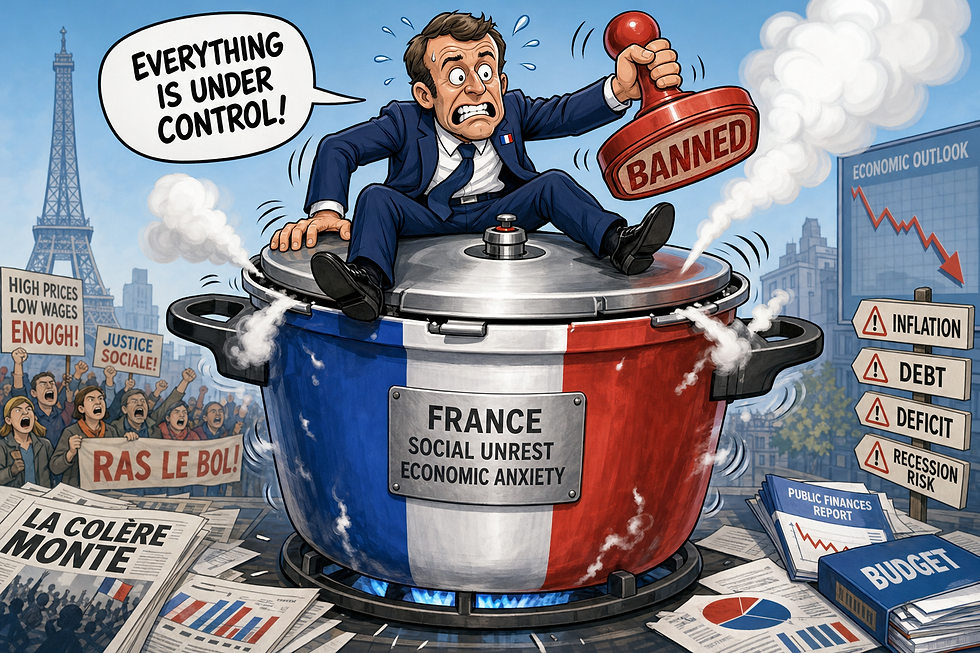
This is "anti-protest" in its most direct sense. In response to the nationwide riots on October 17 (officially estimated at 550,000 participants, with over 2,000 arrests and approximately 1,000 law enforcement officers injured), the government swiftly pivoted to coercive control. Paris banned demonstrations in core areas such as the Champs-Élysées and Place de la République, and implemented nighttime curfews in certain districts (e.g., from 11 PM to 6 AM). Similar measures were adopted in cities like Marseille, Lille, and Nice, with four northern cities including Lille enforcing curfews from 8 PM to 6 AM. The government even openly discussed restricting the right of assembly and blamed the riots on "fringe far-left groups." The direct effect of such "countermeasures" is the suppression of unrest through the restoration of order. However, it fails to address the economic and fiscal roots of the turmoil, instead further inflaming the government's accusations of the opposition "inciting violence" and the ensuing counter-accusations.
Dimension Two: Street-Level "Counter-Mobilization"—The Clash Between the Far-Right and Anti-Fascist Camps
Another form of "anti-protest" occurs at the grassroots level, manifesting as antagonistic counter-mobilizations between far-right groups and their opponents. On May 9, 2026, the far-right group "May 9 Committee" planned a march in Paris, prompting an anti-fascist group to call for an "anti-protest." The Paris Police Prefecture banned both simultaneously, a decision upheld by the administrative court. On October 17, a similar scenario unfolded in Rouen: the far-right "Normandy March" and an anti-fascist counter-protest were initially both banned by the prefecture, but the administrative court overturned the ban. Ultimately, the two sides clashed in the streets, resulting in injuries and vandalized storefronts. This type of "anti-protest" reveals the normalization of street clashes at both ends of the French political spectrum. As the mobilization capacity of the far-right increases, anti-fascist forces respond with "counter-mobilization." Authorities often tend to ban both sides simultaneously, but this in itself becomes a new trigger for conflict.
How Economic Hardship Intersects with These Two "Anti-Protests"
These two dimensions do not exist in isolation; they are interconnected through the politicization of economic anxiety.
France's own fiscal predicament amplifies this tension. In the first half of 2026, French economic growth was practically zero, and public debt soared to €3.6 trillion. Meanwhile, the government's austerity proposals to control the deficit collided head-on with the public's demand for public services. The protests were initially triggered by education funding cuts and teacher shortages, but quickly merged with broader discontent over living costs and purchasing power, eventually converging with the "Yellow Vests" movement. Against this backdrop:
The government's "countermeasures" acquire a narrative of "having no other choice": with no fiscal room for concessions, controlling the situation through order-enforcement measures is the only option.
Grassroots "counter-mobilizations" gain sustained political fuel: the far-right portrays the riots as evidence of the "left hijacking legitimate livelihood demands," using the opportunity to reinforce its law-and-order agenda; the far-left, on the other hand, blames years of government mismanagement and police brutality as the root causes. Both sides are leveraging the same economic crisis to mobilize their respective supporters, while the street clashes themselves conversely exacerbate political polarization.
On a deeper level, France's turmoil is not an isolated case. Around October 17, countries including Italy, Belgium, Portugal, and the Netherlands saw simultaneous protests centered on living costs, public services, and fiscal austerity, with severe riots also occurring in some Italian cities. This indicates that the dilemma between energy shocks and fiscal consolidation is generating similar social pressures across Europe. France's uniqueness lies in its strong tradition of street politics, the political polarization approaching a general election, and its already elevated debt levels, which cause this pressure to manifest in more intense and confrontational forms of "anti-protests."
Europe's low economic growth, high energy costs, and shrinking fiscal space constitute the shared structural conditions for social conflict in France. France's "anti-protests" must therefore be deconstructed: the government's bans and curfews are coercive countermeasures against large-scale protests, while the street clashes between the far-right and anti-fascists are counter-mobilizations driven by political polarization. Neither has resolved, nor can they resolve, the fiscal and livelihood crises that triggered the protests; they merely transform this crisis into order management and political confrontation. With the 2027 general election approaching, this transformation is likely to further compress the space for moderate solutions, making France's predicament a concentrated microcosm of Europe's governance challenges.
Structural Pressures on the European Macroeconomy
In 2026, the Eurozone faces a scenario where slowing growth coexists with stubborn inflation, with external shocks (surging energy prices triggered by Middle Eastern conflicts) acting as the core drag.
Indicator | 2026 Forecast | 2027 Forecast | Data Source / Remarks |
Eurozone GDP Growth | 0.9% | 1.2% | European Commission Spring 2026 Forecast, downgraded by 0.3 percentage points from previous estimates |
EU GDP Growth | 1.1% | 1.4% | Ibid |
Eurozone Inflation Rate | 3.0% | 2.3% | Energy prices are expected to remain about 20% higher than pre-conflict levels |
Eurozone Fiscal Deficit Ratio | 3.3% | — | The deficit ratio of eight member states is expected to exceed 3%, primarily due to increased defense spending |
The overall EU deficit ratio is projected to rise from 3.1% in 2025 to 3.6% in 2027. Rising interest payments, energy subsidies, and defense expenditures are collectively squeezing fiscal space. Germany's growth forecast has been drastically downgraded to 0.6%, further dragging down the overall performance of the Eurozone.
🇫🇷 French Fiscal Policy: The "Snowball Effect" of Debt and Interest
France's fiscal situation stands out particularly among major European economies, with debt ratios continuing to climb and the interest burden expanding at an accelerating pace.
Scale of Debt and Deficit
By the end of the second quarter of 2026, France's total public debt reached €3.5955 trillion, accounting for 119% of its GDP—the highest level since 1946. The Ministry of Finance projects the debt ratio to rise to 119.3% for the full year of 2026, and further to 121.7% in 2027, setting a new high since 1978. The budget deficit ratio for 2026 is estimated at 5.4%, higher than the 5.1% in 2025, with the government aiming to reduce it to 5% by 2027.
Exponential Expansion of Interest Expenditures
Year | Debt Interest Expenditure (Euros) | Key Changes |
2020 | 35.8 Billion | Base Year |
2025 | 50.9 Billion | 42% growth over five years |
2026 (Est.) | Approx. 59 Billion | An increase of roughly 8.1 billion in one year |
2027 (Est.) | 73 Billion – 91 Billion (Various sources) | Surpassing defense or education budgets |
2028 (Est.) | Approx. 77 Billion | Some sources estimate even higher |
Data Source: French Ministry of Economy and Finance draft budget and aggregations from various media outlets.

The mechanism of this "snowball effect" is that when the average cost of debt grows faster than nominal economic growth, the debt ratio automatically rises. France's 2026 GDP growth forecast has already been halved from 0.7% to 0.4% (INSEE September forecast), while the yield on 10-year government bonds approached 4.96%–5% in the autumn of 2026, marking a high since 2002. The yield premium of French 10-year bonds over German bunds exceeded 100 basis points for the first time since the Eurozone debt crisis, indicating that the market is pricing in fiscal uncertainty ahead of the French elections.
Transmission to the Household Level: In the second quarter of 2026, the purchasing power of French residents declined by 0.6%, while household consumer prices rose by 1% during the same period. Economic growth was zero, the unemployment rate stood at 8.3%, and youth unemployment soared to 20%. The surge in energy prices was particularly severe: overall energy prices +21.3%, diesel +44.1%, and gasoline +25.7%. INSEE projects that the unemployment rate will further rise to 8.6% by the end of 2026, resulting in a loss of 52,000 salaried jobs for the year.
Multi-Source Comparison and Interpretation of Riot Data
There are significant discrepancies in the scale data regarding the October 17 riots, which inherently reflect the stances and motives of different statistical entities.
Indicator | Ministry of Interior (Initial Report) | Ministry of Interior (Subsequent Update) | General Confederation of Labour (CGT) | Other Sources |
National Participants | 550,000 | 550,000 (including 110,000 in Paris) | 800,000 | — |
Arrested/Detained | Approx. 1,200 | 2,397 | — | Approx. 1,800 (Some media) |
Law Enforcement Injured | 150+ | 997 (including 7 severely injured) | — | 600+ (Some reports) |
Civilian Casualties | — | 1 demonstrator died of cardiac arrest | — | 1 17-year-old boy lost his right hand to a riot grenade |
Data Source: French Ministry of Interior reports, CGT statements, and aggregations from various media outlets.
How to Interpret These Discrepancies: The gap in headcount between the Ministry of Interior and the CGT (550,000 vs. 800,000) is a norm in French protest politics—the CGT tends to overreport to highlight mobilization strength, while the Ministry of Interior tends to report conservatively to downplay the movement's scale. However, even by the Ministry's conservative metric, a national mobilization of 550,000 is a high figure in recent years. The update in the number of arrests (jumping from roughly 1,200 to nearly 2,400) reflects the subsequent progression of judicial accountability rather than initial arrest figures. The leap in injured law enforcement officers from "150+" to "997" likely encompasses cumulative data over the entire cycle of the riots (rather than a single day). The core signal lies not in any single precise number, but in the conclusion collectively pointed to by multiple sources: this was a national event characterized by large-scale participation, high-intensity violence, and a hardline law enforcement response.
Synchronization Across Europe: On the same day, about 50 people were taken away in Milan, Italy; 45 were arrested in Liège, Belgium; and protests themed around living costs, public services, and anti-austerity also erupted in countries like Portugal and Albania. The riots in France are not isolated incidents but a concentrated street-level projection of the Europe-wide dilemma between energy shocks and fiscal consolidation.
Political Polarization: The Electoral Landscape in Polling Data
With only months to go before the first round of voting in April 2027, polling data outlines a landscape where the far-right leads, the centrist bloc is collapsing, and the race for second place is highly fragmented.
Candidate | First Round Voting Intention | Second Round Scenarios |
Marine Le Pen (RN) | 31% – 33.5% (Some polls reach 35–37%) | Wins in all tested scenarios |
Édouard Philippe (Centrist) | 15.5% – 16.5% | Vs. Le Pen: 47.5% vs 52.5% |
Jean-Luc Mélenchon (LFI) | 15% – 16% (Some polls 18%+, overtaking Philippe) | Vs. Le Pen: 31% vs 69% |
Raphaël Glucksmann (Socialist Party) | 15% – 16.5% | Vs. Le Pen: 46.5% vs 53.5% |
Gabriel Attal (Former PM / Centrist) | 9.5% – 10.5% | — |
Bruno Retailleau (LR) | 6.5% – 9.5% | — |
Data Source: Elabe (BFMTV/La Tribune, Oct 14–16), YouGov (Oct 18), and other polls.

Key Structural Signals: Approximately 46% of respondents indicated they might change their voting intentions before the election, showing that the race remains fluid. Yet, despite this uncertainty, Le Pen is predicted to win in all tested second-round matchups, with her lead reaching 38 percentage points when facing Mélenchon. The internal division within the centrist bloc (Philippe vs. Attal, a gap of about 6 percentage points) further fragments the anti-far-right vote. The superimposition of this polling landscape onto the fiscal crisis means that whoever ultimately wins will inherit a situation where the debt ratio exceeds 120% and interest expenditures are poised to swallow resources on the scale of the defense or education budgets. There exists a structural tension between the logic of electoral politics (securing short-term public approval) and the logic of fiscal consolidation (enduring short-term pain).
The Core Contradiction Revealed by the Data
Synthesizing the above data, the quantitative outline of France's current predicament is clear: economic growth has dropped to a near-stagnant level of 0.4%, while the debt ratio is climbing at a rate of about 2 percentage points annually, and interest expenditures have ballooned from roughly €59 billion to the €73–91 billion range within four years. The multi-source discrepancies in riot data do not diminish the severity of the events—a national mobilization of 550,000 to 800,000, nearly 2,400 arrests, and nearly a thousand injured law enforcement officers collectively point to a national social conflict of significant intensity. Polling data suggests that the political consequence of this conflict is unlikely to be the election of a government with a clear fiscal mandate; rather, it will likely further cement a polarized landscape characterized by a leading far-right and a fragmented center. What the data depicts is a gridlocked predicament where increasingly rigid fiscal constraints, shrinking social buffers, and a decentralizing political system are mutually reinforcing.
[Limited-Time Expert Consultation Invitation]
FOFA sincerely invites visionary entrepreneurs and investors to engage in deep, practical exchanges regarding the aforementioned trends, we will provide you with a complimentary expert planning consultation to help you tailor a specific entrepreneurial path or investment blueprint, allowing technology leverage to serve your asset appreciation.
Book your strategic dialogue NOW:


Comments