
Reconstructing Strategic Value: Mapping the Core Investment Landscape of the "Super Intelligence (SI)" Era


As U.S. officials and technology giants comprehensively upgrade their AI development strategies to "Super Intelligence" (SI), the valuation logic of the capital markets is undergoing a fundamental reconstruction. From Jensen Huang’s concept of "SI factories" to Elon Musk’s emphasis on a "hundreds of gigawatts energy gap," this technological revolution has shifted from mere "software algorithm applications" to a comprehensive national power competition heavily reliant on physical infrastructure, national security, and energy transition.
This strategic pivot not only alters the trajectory of the U.S.-China technological rivalry but also delineates four core axes for value investing in the capital markets over the next 5 to 10 years:
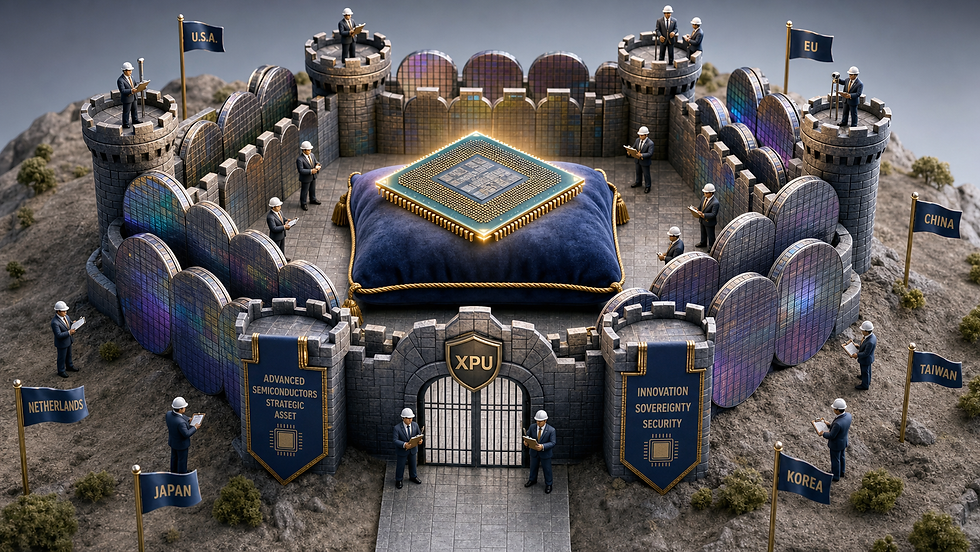
I. Investment Axis 1: "Computing Power as Geopolitics" — Semiconductors and Advanced Packaging Amidst Strategic Encirclement
In the SI era, chips are no longer merely components of electronic products; they are strategic materials and the beating heart of "Super Intelligence factories."
Foundry & Advanced Packaging: As model complexity grows exponentially, the demand for High Bandwidth Memory (HBM), Silicon Photonics, and advanced packaging technologies like CoWoS will continue to explode. Semiconductor leaders and equipment providers that master these proprietary technologies possess immense pricing power and are highly irreplaceable.
Autonomous and Controllable Supply Chains: Amidst the great power competition between the U.S. and China, both nations are driving the localization and de-risking of their supply chains. Semiconductor equipment and material manufacturers capable of establishing facilities in the U.S. (such as the Nvidia supply chain ecosystem) or achieving domestic substitution in China will enjoy substantial policy dividends and long-term order security.
II. Investment Axis 2: Breaking Physical Limits — "Energy and the Grid" Become the Most Expensive Bottleneck
Elon Musk has explicitly pointed out that the most tangible limitation to advancing SI lies in energy supply; an increment of hundreds of gigawatts (GW) alone is enough to shift the priorities of global power investments.
Extreme Grid Infrastructure: Traditional power grids simply cannot bear the instantaneous high loads of massive data centers (SI factories). Hardware manufacturers upgrading High-Voltage Direct Current (HVDC) systems, smart grids, transformers, and power distribution equipment will usher in a long-term structural bull market.
Next-Generation Clean Energy: Because SI computing requires continuous 24/7 low-carbon baseload power, Small Modular Reactors (SMRs), nuclear fusion supply chains, and large-scale Battery Energy Storage Systems (BESS) have transitioned from visionary concepts to rigid demands, with tech giants directly contracting and purchasing them.
Space-based Compute: Musk's mention of "space solar power and orbital computing" has driven a revaluation of Low Earth Orbit (LEO) satellites, space launch cost optimization, and space-based communication technologies. The aerospace defense and micro-satellite ecosystems are welcoming a new wave of long-term capital injections.

III. Investment Axis 3: From Software to Physical Reality — "SI Factories" and Blue-Collar Reindustrialization
Jensen Huang emphasized that SI data centers are essentially "physical factories" producing high-value knowledge. This will trigger a massive wave of domestic reindustrialization and automation within the United States.
Industrial Automation and Embodied AI: As super intelligence acquires a physical "body," robotics will no longer be confined to stationary arms but will evolve toward humanoids with autonomous learning capabilities and industrial autonomous vehicles. Automation sensors, reducers, and motor control components will reach a critical inflection point in demand.
Cooling Solutions: The heat generated by high-density SI chips has far exceeded the limits of traditional air cooling. Liquid cooling technologies, immersion cooling, and specialized coolant manufacturers have become indispensable, standard components for constructing "SI factories."

IV. Investment Axis 4: Civil-Military Integration and Autonomous Systems — The Revaluation of Defense Tech
As seen from rapid defense initiatives like the Pentagon's Project Meridian, military procurement models are undergoing a paradigm shift. The long-cycle model of the traditional military-industrial complex is rapidly giving way to tech companies capable of providing autonomous systems and rapid iteration.
Autonomous & Swarm Systems: Drones, unmanned vessels, and automated defense systems integrated with SI are becoming the fastest-growing areas in future defense budgets.
Cybersecurity & Biosecurity: The White House Accord on Super Intelligence lists cyber offense/defense and biosecurity as the core of its four-tier control and auditing framework. Specialized cybersecurity software and auditing service agencies capable of providing security audits, AI-generated content identification, and defense against autonomous hacker attacks will secure stable revenues driven by compliance regulations.
Conclusion: Strategic Implications for Future Asset Allocation
The investment logic for the next 10 years has shifted from merely seeking "high-growth software SaaS platforms" to identifying "hardcore assets that control physical bottlenecks":
Embracing "Hard Assets": Power, grids, advanced packaging, cooling equipment, and military technology are becoming formidable moats to protect assets against market volatility.
Focusing on Compliance and Auditing Dividends: The "third-party auditing," "internal oversight," and "independent committee" models established by the White House Accord will create an entirely new industry chain of "SI compliance and cybersecurity services."
Polarization of Strategic Allocation: On one end are U.S.-based giants with immense innovation momentum and capital scale (controlling infrastructure and terminal ecosystems); on the other end are midstream hardware enterprises capable of addressing localized supply chain gaps and providing energy solutions.
References
U.S. Government Documents
The White House. (2026, September 29). Executive Order: Inaugurating The Era Of Super Intelligence. WhiteHouse.gov.
The White House. (2026, September 29). Fact Sheet: President Donald J. Trump Inaugurates The Era of Super Intelligence. WhiteHouse.gov.
Historic Accords and Signed Documents
The White House & Tech Leaders. (2026, September 29). White House Accord on Super Intelligence: Joint Commitment on Frontier Responsibilities (Signed by Donald J. Trump, Sundar Pichai, Dario Amodei, Mark Zuckerberg, Greg Brockman, Elon Musk, Jensen Huang).
Video & Media Sources
USA TODAY. (2026, September 30). Jensen Huang says AI is 're-industrializing' the US, Elon Musk says it 'needs a lot of energy' [Video]. YouTube.
The Independent / AP. (2026, September 30). Trump renames AI to 'super intelligence' alongside top tech CEOs.
Legal & Media Analysis
Freshfields Digital Infrastructure. (2026, October 1). Trump Executive Order Mandates Shift to "Super Intelligence".
The Times of India / Reuters. (2026, September 29). ‘Bigger than the internet’: Trump officially renames AI as ‘super intelligence’.
[Limited-Time Expert Consultation Invitation]
FOFA sincerely invites visionary entrepreneurs and investors to engage in deep, practical exchanges regarding the aforementioned trends, we will provide you with a complimentary expert planning consultation to help you tailor a specific entrepreneurial path or investment blueprint, allowing technology leverage to serve your asset appreciation.
Book your strategic dialogue NOW:


Comments