
Tesla FSD Breaks Ground in Europe — Dutch Approval Opens the Door to EU Recognition, Unlocking Trillion-Dollar Valuation Potential

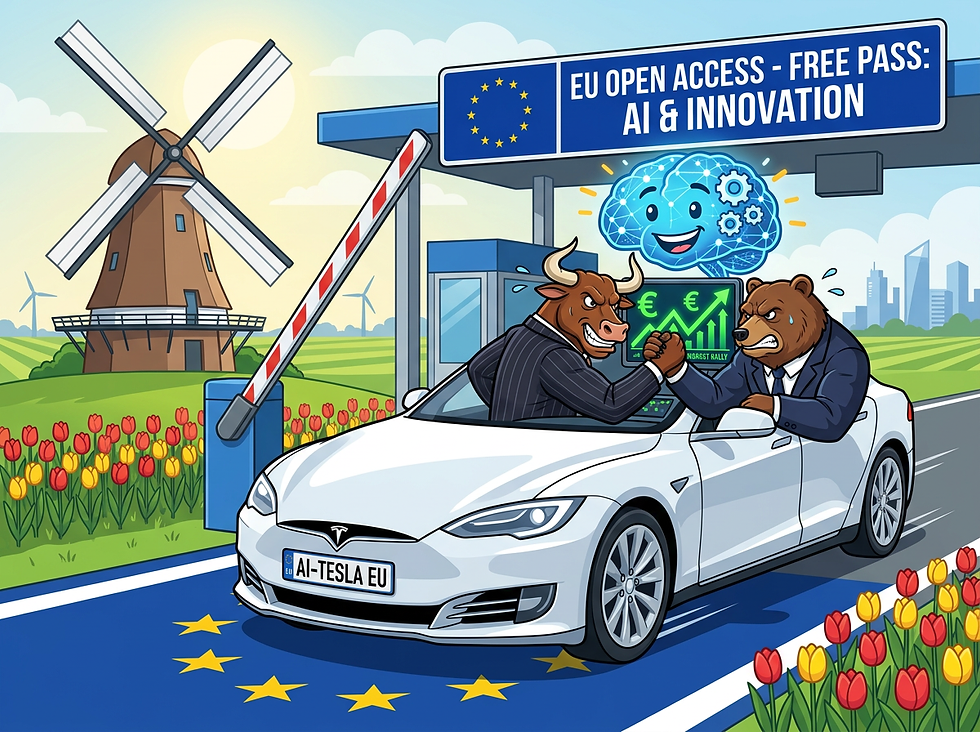
Tesla has achieved a significant regulatory milestone in Europe. The Netherlands Vehicle Authority (RDW) has officially approved Tesla’s Full Self-Driving (FSD) Supervised system for use on Dutch highways and urban roads, subject to active human supervision. This marks the first formal regulatory authorization of Tesla’s autonomous driving software within Europe and establishes a pathway toward broader EU-level mutual recognition.
The approval follows more than 1.6 million kilometers of real-world road testing and over 13,000 supervised user trial experiences. Tesla submitted thousands of pages of compliance documentation and leveraged Article 39 of EU Regulation 2018/858, enabling initial approval at the member-state level before seeking EU-wide validation. Belgium and Ireland have already signaled their willingness to recognize RDW’s certification outcome, suggesting potential momentum toward cross-border regulatory alignment.
Importantly, EU vehicle approval standards are materially stricter than those in the United States, meaning the EU version of FSD Supervised is not directly comparable to its U.S. counterpart. RDW stated that, when used properly, the system is expected to contribute positively to road safety. The agency has also indicated it will formally apply for EU-wide deployment authorization.
Strategic Implications: From Hardware Manufacturer to AI-Driven Platform
The European breakthrough carries implications far beyond a feature unlock. It directly reinforces Tesla’s core valuation narrative — the transformation from an automotive hardware manufacturer into an AI-driven software subscription and mobility platform.
Tesla’s long-term growth thesis hinges on large-scale deployment of autonomous driving technology and the expansion of Robotaxi services. The company’s $1 trillion valuation narrative is substantially tied to CEO Elon Musk’s thesis that AI-powered autonomous software and autonomous ride-hailing networks will evolve into primary revenue engines.
In February 2026, Tesla globally discontinued the one-time lifetime FSD purchase option, fully transitioning to a subscription-based model. Wall Street widely interpreted this shift as a decisive move toward SaaS and AI economics. FSD global subscribers have now surpassed 1 million. While this remains significantly below the 10 million active-user threshold embedded in Musk’s compensation targets, the growing base of recurring subscription revenue has already begun reshaping analyst valuation frameworks.
European Sales Pressure Elevates the Importance of FSD
The regulatory progress comes at a critical time. Tesla’s European sales declined 27.8% year-over-year in 2025, with market share shrinking from 2.4% to 1.8%. Product-cycle aging, intensified local competition, and reputational volatility tied to executive-level political commentary have collectively pressured demand.
Against this backdrop, FSD is positioned not merely as a technological upgrade, but as a demand catalyst capable of differentiating Tesla’s vehicles in a highly competitive European EV landscape.
Market Outlook: A Divided Narrative Around FSD and Robotaxi
Institutional investors remain sharply divided. The bullish camp centers its thesis on successful EU-wide FSD mutual recognition and accelerated Robotaxi rollout. Tesla’s stated goal of expanding Robotaxi services to more than 30 cities by 2026 represents a key inflection point for validating the AI-platform narrative.
Conversely, skeptics question regulatory scalability, adoption velocity, and the timing of meaningful profitability from autonomous services.
The coming 12–24 months will likely determine whether Tesla’s European regulatory breakthrough evolves into a continent-wide commercialization wave — or remains a localized milestone. For valuation-sensitive investors, FSD’s EU mutual recognition trajectory and Robotaxi expansion progress remain the primary catalysts to monitor.


Comments